Osprey ( Pandion haliaetus ) have returned to the Bay to begin the spring season. The call of a laughing gull ( Leucophaeus atricilla ) sounds cheerful, as if reminding everything that warmer weather is on the way. Water oaks are beginning to burst into their pollen-heavy yellow flowers and neighbors are mulching their yards already fragrant from the blossoming of cultivated saucer magonlias (Magnolia x soulangeana). The orchestra of the impending hot summer is beginning to tune. Spring has started across the southern Chesapeake Bay. The Lafayette River on a balmy early spring evening. March 12, 2013. Colley Avenue bridge. (Click to enlarge)
Posts
Green is the color of wild: Why wildlife biologists need to know their plants
- Get link
- X
- Other Apps
"Plants are boring!" "I could care less about plants." These are words I hear spoken all too frequently by wildlife biologists and wildlife managers. I can understand where they're coming from. Wild animals are mysterious, exciting, showy, cute, ferocious, or just plain cool. Wildlife biologists are field biologists who are often responsible for wildlife management, or the manipulation of wildlife populations and their habitat. Wildlife management is important for a number of different reasons, including predator control, habitat maintenance/protection, protecting endangered species, and resolving people-wildlife conflicts. A large array of wildlife specialists such as herpetologists (reptiles and amphibians), mammalogists, ornithologists (birds) and others frequently venture into the great outdoors hoping to learn more about the biology and ecology of wild animals in an effort to protect them. Yet ...
Making the Chesapeake for everyone: My justification for affirmative action programs in Norfolk, Virginia
- Get link
- X
- Other Apps
Please note: This blog post is in a draft stage and is intended to outline my thoughts and feelings on an important environmental issue in a certain region. I have yet to include proper citations or to double-check my facts. Please feel free to comment if you feel I have made some extra-erroneous remarks or overly belligerence errors, and I will work promptly to correct them. Introduction Norfolk, Virginia is located in a region referred to as the "Tidewater area" and upon first glance of a satellite image of the region (see Figure 1) the name readily becomes apparent. Long and narrow stretches of tidal "rivers" are woven throughout an otherwise highly urbanized area. Figure 1: Satellite image of Norfolk, VA and surrounding areas. Imagery ©2013 TerraMetrics Those tidal waters are directly connected to the Chesapeake ...
Update: Controlling invasive privet at Hoffler Creek Wildlife Preserve
- Get link
- X
- Other Apps
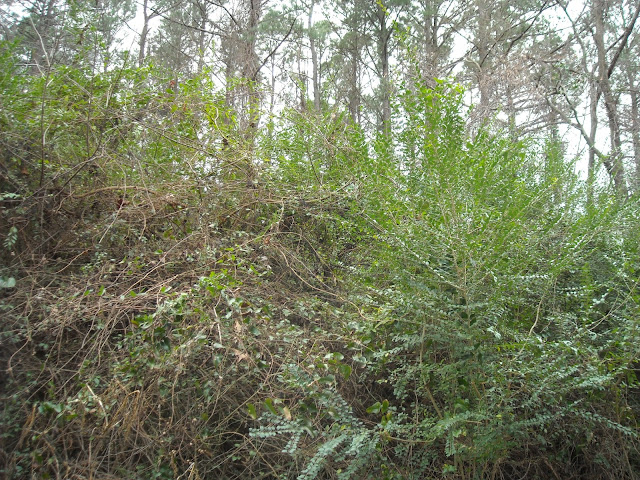
In a previous blog post , I mentioned that I was starting a natural resource management project at a local wildlife preserve. Natural resource management involves the deliberate manipulation of natural ecosystems in order to enhance it's ecological function. On of the most common activities of natural resource managers today is that of invasive species management. My project falls within this category, and as you can see from Photos A and B, European privet ( Ligustrum vulgare L.) can quickly dominate the understory of a wooded area eliminating valuable food resources that a diverse array of native plants could provide. Photo A: A monoculture of privet chokes out the understory of a forest near the trail center at the Hoffler Creek Wildlife Preserve in Portsmouth, VA. January 6, 2012. Photo B: Large privet bushes. Same location as Photo A. Originally, I had intended to create th...
Our natural capital
- Get link
- X
- Other Apps
When people travel to Washington, DC, one of the first things they will likely do is visit the museums, monuments, and restaurant-filled neighborhoods. As a naturalist, my first instinct is to visit the parks and natural areas in any region I travel to. Yet why would I try and go on a safari in the middle of Washington, DC? Perhaps it may be surprising to know that our capital has a lot of natural capitol. Natural capitol is any sort of natural resources that has some positive value. For example, wetlands are usually abundant in natural capitol because the provide us with water filtration, are biologically diverse, act as a flood control mechanism, and they provide us with a source of recreation. In Washington, DC, tidal wetlands with fresh water along the Potomac River provide a refuge for a diverse array of wildlife in a densely urban area (see photo A). The Washington metro area is do...
Envisioning a climate-change ready and ecofriendly waterside vacation home complex
- Get link
- X
- Other Apps
The following map shows my vision for what a vacation town-home complex in Norfolk, Virginia could look like. Norfolk lies within the lower watershed of the Chesapeake Bay , America's largest estuary. Home to vast marine resources- and a vast human population, people who settle in this region should do everything they can to minimize impacts to this sensitive coastal ecosystem. Some of the content in this map will no doubt be controversial. But we must be willing to make changes such as those presented in this map if we are to live sustainability - and happily - in a low elevation coastline. Please note: this map is not meant to be an engineering plan for this site. It is merely a visual concept model of what would take place here. Please click on map to enlarge.