Posts

From fire to slag and back again: A brief introduction to the Natural History of the Calumet region
Image
Introduction Times moves on, and I have parted ways with the Chesapeake Bay watershed.  I have now assumed a full time position as a naturalist with the Forest Preserves of Cook County in the urban and post-industrial south suburbs of Chicago.  As a native of the southern Great Lakes area, it feels good to return to the friendly and more laid back atmosphere of the Midwest.   Working as a naturalist in the Chicago region will be both rewarding and painstakingly challenging.  In the Chesapeake Bay Watershed, conservation challenges were numerous, and included (but were not limited to) large amounts of trash and debris as well as urban runoff from a seemingly endless population growth.  However, the region seemed well equipped to deal with some of the larger environmental issues, and despite a growing  human population and increased land development, the health of the Chesapeake Bay has been steadily improving (Chesapeake Bay Foundation, 2012). Figure 1:...

Envisioning a new Springhill Lake: Greenbelt Urban Ecology Center

Image
Disclaimer:  The opinions and commentary expressed in this blog post are my own and therefore might not represent the views and policies of the Chesapeake Education, Arts & Research Society, the City of Greenbelt, or any affiliated organization or person.    In 1935, during the Great Depression, the Roosevelt Administration launched the "New Deal" initiative to revitalize America's economy by hiring the unemployed and putting them back to work building new infrastructure and restoring the environment.  One such project was for the federal government to build, construct, and maintain "New Deal Towns" which were intended to be a refreshing alternatives to the developing urban slums of that era.  Each of these planned communities would feature a town center with restaurants, stores, banks, a post office, and other amenities all within walking distance for each resident.  New Deal towns would be arranged into supe...

Natural Notes: Habitat exploration in a Chesapeake Bay park

Image
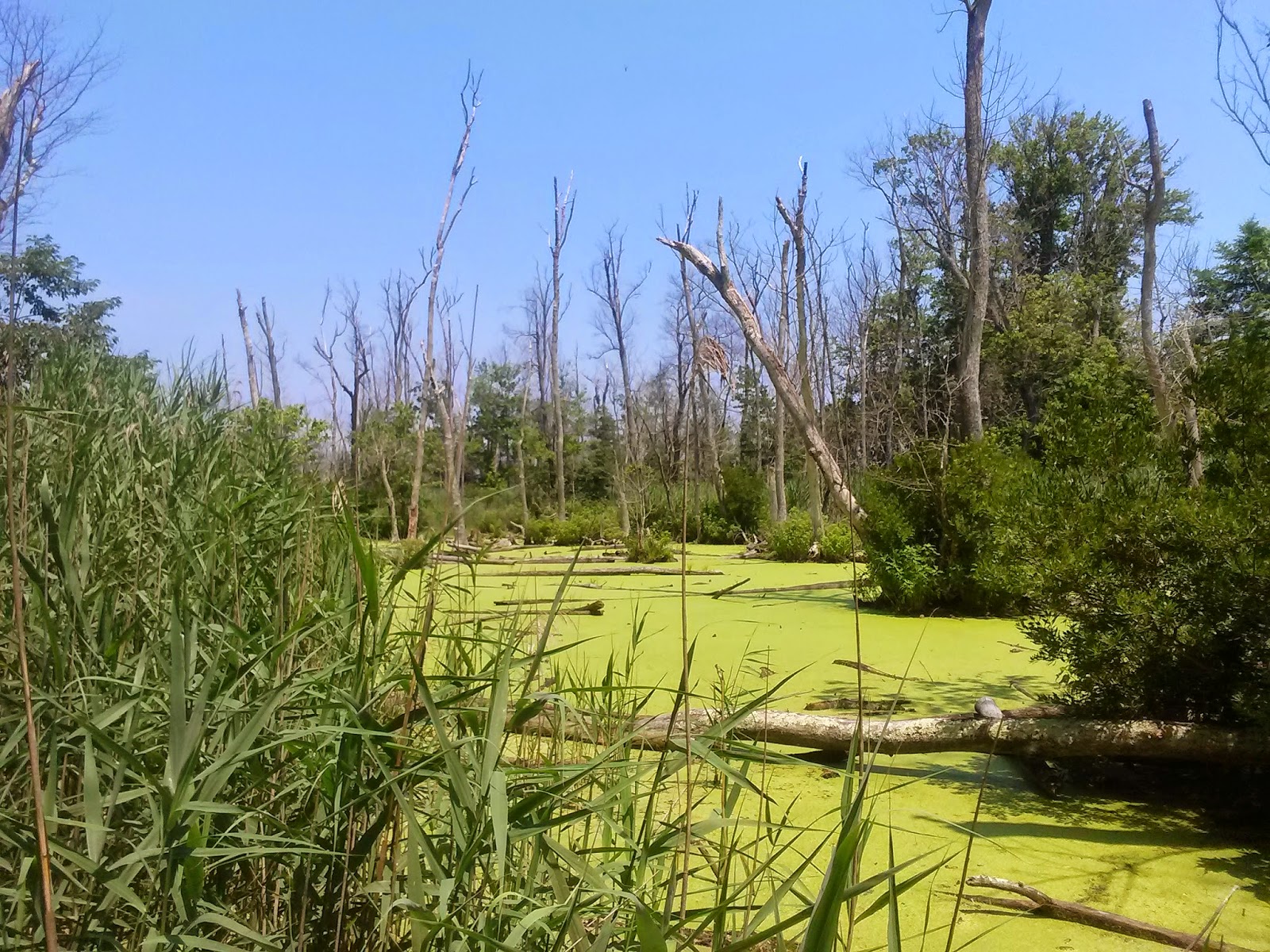
Date:  11 July 2014 Time:  10am-2pm Location:   Flag Ponds Nature Park , Calvert County, Maryland, USA Weather:  85 degrees F, Sunny, 10% cloud cover, calm wind On Friday, July 11th I had the opportunity to participate in a habitat survey and exploration at Flag Ponds Nature Park, a protected natural area along the Chesapeake Bay in Calvert County, Maryland.  The park features coastal plain forest, maritime forest, swamp forest, freshwater marsh (see Figure 1), sand dunes, beach, and shallow brackish tidal marshes.  The coastal plain forest is dominated by various oaks ( Quercus spp. ), Tulip Trees ( Liriodendron tulipifera ), Black Gum (Nyssa sylvatica), and other overstory trees common to the Mid-Atlantic coastal plain.  The understory consists primarily of Spicebush ( Lindera benzion ), American Holly ( Ilex opaca ), Mountain Laurel ( Kalmia latifolia ), and other small trees and shrubs.  Wet lowland areas consisted of red maple ( Acer ...

Down in the plain: Mountain Laurel?

Image
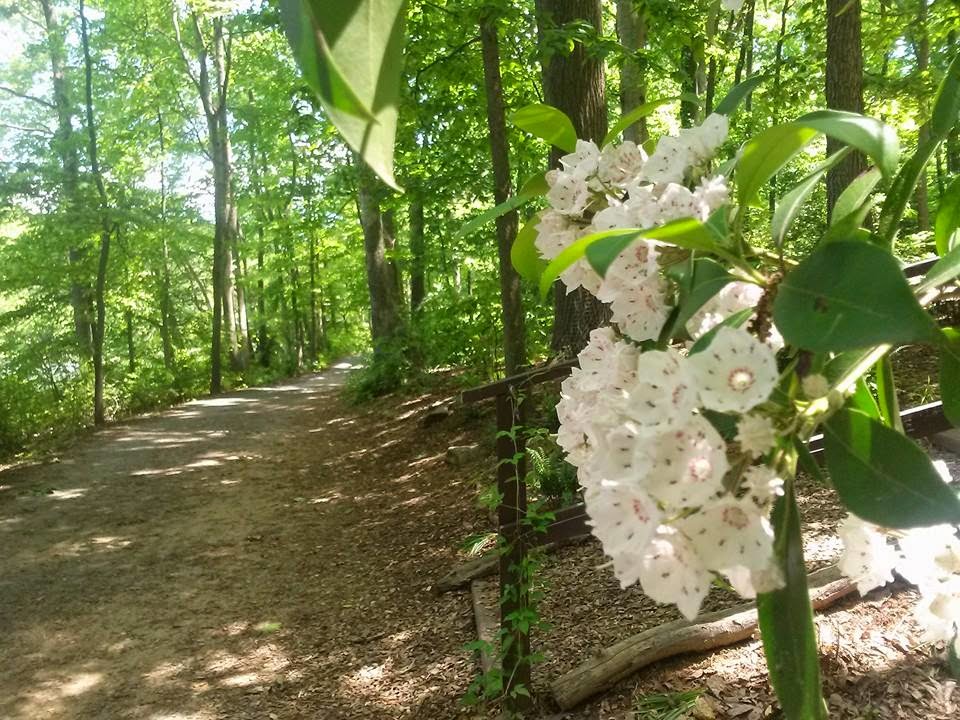
Figure 1:  Mountain Laurel ( Kalmia latifolia ) in bloom along the Greenbelt Lake Trail at Buddy Attick Park in Greenbelt, Maryland.   One thing I love about spring in the Mid-Atlantic and Southeast is the showy flowers of Mountain Laurel ( Kalmia latifolia ).  Native to the eastern half of the United States from Pennsylvania down into Alabama and Georgia, this large evergreen shrub has a misleading name.  First of all, the shrub is not actually a species of laurel but is in fact a Rhododendron.  Secondly, mountain laurel does not necessarily grow on mountains.  In the Appalachian Mountains, mountain laurel does well on windy, somewhat exposed areas near the peaks of large hills.  However, in the coastal plain of the Chesapeake Bay region, mountain laurel grows in lightly disturbed, well-drained soils often in woodland understories (see Figures 1 and 2).  Right around May and early June, mountain laurel's membership in the rhododendron and aza...

Like a spring peeper

Disclaimer:  The opinions and commentary expressed in this blog post are my own, and do not necessarily represent the views or policies of the Chesapeake Education, Arts and Research Society (CHEARS), the City of Greenbelt, Volunteer Maryland, the Corporation for National and Community Service (Americorps), or any affiliated parties. My job as a Volunteer Maryland Coordinator is to develop and enhance a volunteer program structure for the Chesapeake Education Arts and Research Society (CHEARS), a small nonprofit based in the DC suburb of Greenbelt, Maryland.  The overall mission of CHEARS is to facilitate community-driven action projects that improve the health of people and the environment in the Chesapeake Bay Watershed.  The structure of the organization is partnership-based, with one of the closest partners being the City of Greenbelt government. Greenbelt is a rather unique town in that it was one of three pl...

Now you can follow my posts via email!

You can now follow each new blog post as I publish it by having it delivered right into your email inbox!  Scroll to the bottom and look for the "follow my posts via email" field. Thanks for reading!

Natural Thoughts: Ode to a New Anacostia

Image
It has been a long and cold winter, and usually after work I head straight home for a nice hot shower. Finally though, the days are starting to get longer and at least a little warmer.  So, the other day I took a badly needed break from all of the chaos at work and went for a stroll along the Anacostia River.  As I walked the pathway that was elevated on a man made levee, I thought about how the river used to be, and I realized that, Never again will the river abound with the diversity of large game fish that it once had. Never again will a wolf howl at a cliff along the Fall Line. Never again will clear and clean water wind past old growth forest. Never again will giant American Chestnuts ( Castanea dentata ) line the banks of the river. Never again will a large cloud of Passenger Pigeons ( Ectopistes migratorius ) darken the daytime sky over the river. Never again will an ivory-billed woodpecker ( Campephilus principalis ) soar across the coastal plain. Never a...