Posts

Natural Notes: Urban Tree ID!

Image
If you're sheltering in place and can't get out to a large natural area, then here are some tips and suggestions for learning about and admiring Chicago's urban street trees.  Enjoy!   Download a free field guide to the Trees of Chicago in Winter: https://fieldguides.fieldmuseum.org/guides/guide/885

Notas naturales: Los aves los cuales se puede ver de tu ventana.

Image
This blog post is my first attempt of publishing entirely in Spanish.  For those that are fluent in Spanish, please lend me your feedback and suggestions for improvement.  Thank you.  - Alex Palmer ~ Si vives en algún lugar alrededor de Chicago que tenga por menos algunos poco arboles, verás a menos algunos aves.  Los aves están en casi todos lugares, pero los lugares con más árboles tienen más especies de aves.  En esto entrada de blog, vamos a aprender sobre algunos aves comunes los cuales puede ver de tu ventana durante el invierno en la región Chicago. Mirlo Primavera .   Esto ave no solo aquí durante la primavera.  Los tenemos también en el invierno.  Sin embargo, la comida de este ave se cambia a frutas en lugar de los gusanos.  Muchas arbustos ornamentales mantienen sus bayas por el vierno, se les proporciona comida durante la clima dura. Fig. 1: Mirlo Primavera. Foto de Jakub FryÅ¡ vía Wikimedia Commons ...

Natural Notes: Native Sunflowers

Image
September is the month of yellow, and for gardeners the easy-to-grow and popular choice of flower  is the Annual Sunflower ( Helianthus annuus ) which adorns garden borders and roadsides across the Chicago Region.  Numerous cultivars of this urban weed have been developed, and the source of commercial sunflowers and sunflower oil are derived from the Annual Sunflower (figure 1).  Figure 1:  Annual Sunflower growing  at the Taylor Street Farms community garden in Chicago.   But prior to European settlement, the Chicago region was largely absent of this tall and showy late-summer wildflower, whose range historically included the south-central United States into the plains and grasslands just to the east of the Rocky Mountains.  Instead, the prairie landscape of Northern Illinois would have been adorned with several species of native sunflowers and sunflower-like plants (figure 2).  Figure 2:  Although virtually absent of the notor...

Natural Notes: A History of some of our most common urban "weeds"

Image
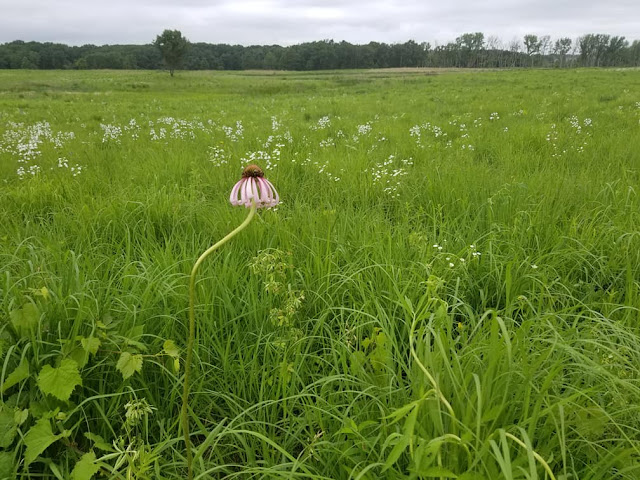
Did you know that Illinois has a state "nickname?"  In fact, most state's do, and the nickname for Illinois is the "Prairie State."  A prairie is an open grassland without much trees that thrives in semi-arid climates, or in the case of Illinois, in areas frequented by wildfires (figure 1).  Wildfires prevent encouragement of woody trees and shrubs to allow sun-loving and deep-rooted prairie grasses and flowers to thrive.  Illinois at one point was covered with about 60% tall-grass prairie, but today less than 1% remains.  The city of Chicago was once a mixture of wetlands and prairies with small patches of forest. Figure 1:  Tallgrass prairie in the northwest suburbs of Chicago.   Over time, however, and with European colonization and eventual industrial development, the landscape and the flora and fauna found upon it changed dramatically.  Removal of topsoil, chemical pollution, introduction of non-native and invasive plants and other...

Natural Notes: While you were in, wild animals were out

Image
Spring is finally here!  Birds are chirping, leaves are budding out, and some of you may be venturing over to the garden, bumping into neighbors that you probably haven't seen in several months.  The snow is gone for the season (hopefully) and spirits are high.  It has been a long and cold winter, and a general feeling of relief washes over everyone as the warm rays of sunshine trickle down.  But during the long and cold winter wild animals in the University Village neighborhood had to endure it all.  Wildlife in our region must do one of three things in order to survive winter.  They either have to hibernate (or go dormant), migrate (get the heck out), or insulate themselves (grow a nice thick winter coat).  The third option is the hardest, and unlike people, animals don't have a choice as to which option they choose, but rather they must possess physical adaptations that allow them to survive harsh winter conditions.  Let's take a look at a ...

Natural Notes: Trills from the urban sky

Image
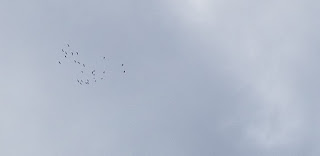
If you're out prepping your garden bed for winter, listen closely.  A little more closely!  Alongside the noise of the city and up in the sky, you might here a chorus of trills.  Look up!  Those hauntingly primeval sounds might be those of the Sandhill Crane ( Antigone canadensis ). Yes, we have cranes in the Chicago region!   And right around Thanksgiving is one of the best times to see flocks of them flying over (figure 1) as they make their way south for the winter.  In fact, over 80,000   of these elegant, heron-like birds with wingspans in excess of 6 feet fly over the Chicago region during fall and spring migration each year. Figure 1:  A flock of migrating Sandhill Cranes in flight.   If you are a city dweller, more often than not the best view you'll get of these birds is like the one shown in Figure 1.  As such, people often confuse them with geese.  However, just a few extra moments of observation is al...

Natural Notes: Turtles of Cook County

Image
This blog post consists of my notes from a lecture on the natural history of turtles in Cook County, Illinois, delivered by Chris Anchor, wildlife biologist with the Forest Preserves of Cook County.  The lecture and following staff training was conducted at Thatcher Woods in River Forest, IL during the morning of August 29, 2018 to an audience of mostly Forest Preserves staff.   Native Cook County Turtle Species: Common Snapping Turtle ( Chelydra serpentina ) Painted Turtle ( Chrysemys picta ) Spiny Softshell ( Apalone spinifera ) Stinkpot or Musk ( Sternotherus odoratus ) Box Turtle ( Terrapene carolina ) Map Turtle ( Graptemys geographica ) False Map Turtle ( G. pseudogeographica ) Red-eared Slider ( Trachemys scripta ) Spotted Turtle ( Clemmys guttata ) Snapping Turtle Figure 1:  Common Snapping Turtle displaying its jaws Snapping Turtles have jaws that crush prey rather than cut them (figure 1).  Males frequently wander to look for femal...