Posts

Visitor FAQs: Why are birds of prey referred to as 'raptors'?
Image
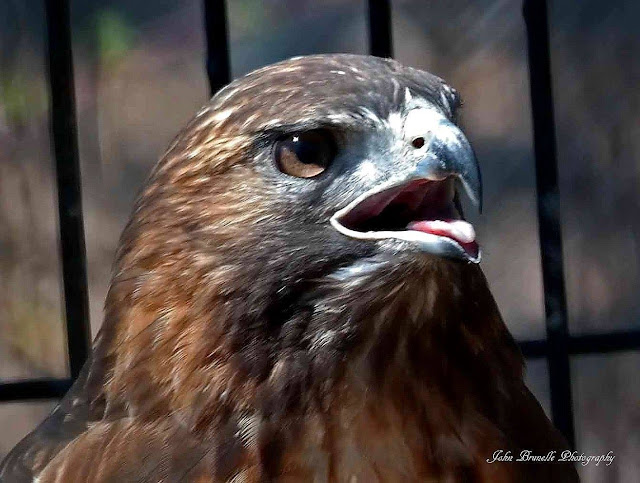
I recently watched the sequel to the Jurassic Park series of movies, Jurassic World.  I was impressed by the fact that it stayed true to the spirit and adventure of the original Jurassic Park movies but with enhanced and modernized special effects.  And of course it featured the small but fearsome "raptors", that were now fully computer animated. The other night I was leading an evening nature walk at the nature center where I work in the south suburbs of Chicago, and we were looking at our resident hawks and owl.  I mentioned that hawks and owls were members of a group of birds known as raptors, or birds of prey.  One gentlemen jumped up and exclaimed, "Raptors?  You mean like dinosaurs?"  I chuckled a bit and explained that the term raptors refers to birds of prey, not the semi-mythical dinosaurs that reach down and grab unobservant bystanders with their giant claws and gnarly teeth. The term raptor is derived from the Latin word "rapere" which loose...

A Sandy and Swampy Urban Island: A summary of ecological problems and solutions at Sand Ridge Nature Center

Image
Introduction Since September of 2014, I have been serving the Forest Preserves of Cook County as a naturalist at a Chicago-area suburban nature education center situated in a 300 acre urban nature preserve.   Sand Ridge Nature Center  (SRNC), which geographically straddles the border of South Holland and Calumet City in Illinois, is named for the ancient high Toleston Beach Ridge that formed as the water levels of Lake Michigan began receding after the end of the last major ice age (figure 1) (Forest Preserves of Cook County, 2016) .  The former 6,000 year-old beach ridge is still partially intact in several forest preserves, with one the longest remaining stretches on the northern end of the nature center property along Michigan City Road (figure 2).  The present extent of Sand Ridge Nature Center includes all of the land north of U.S. Highway 6 to Michigan City Road, then from Paxton Avenue east to Illinois Highway 83 (Torrence Avenue) along the municipal boundari...

(Not So) Natural Notes: Chicago's new Loop Link

Image
If you're traveling around town, which would be your preferred mode of travel, train or bus?  Chances are, you would choose a train.  Why is that?  Trains are easy and fun to ride, and they're quick.  They also cost less than driving, and of course using public transportation in general can reduce carbon emissions and smog, helping to improve local air quality and climate.   Why would you NOT choose a bus?  Well for one thing buses are susceptible to getting caught in traffic jams, whereas trains are free of that burden.  On top of that, buses also make frequent stops - sometimes every few blocks - which can make travel painfully slow.  For example, during rush-hour traffic in the Washington, DC metro area, buses can sometimes run 45-minutes to an hour behind schedule because of traffic and frequent stops, even though they might only be traveling a few miles or less.   So would the solution to this problem be to build new light rails o...

Natural Notes: How Trees Built America

Image
This blog post consists of notes from a lecture on the cultural significance of certain trees in the early stages of the United States.  The slideshow lecture took place at Sand Ridge Nature Center in South Holland, Illinois on 13 January 2016.  The speaker was Michael Panygnot, a resource technician with the Forest Preserves of Cook County.   Ship and Housing Construction When pioneers established cities in the "New World", they often developed areas that were former Native American settlements.  Many early settlers were sponsored by companies to log and clear forests.  Pioneers were not generally good with axes and did not know how to properly nor safely fell trees.  It generally took pioneer families one year to clear land, built houses, and plant crops.   Certain tree species served an important economic and cultural purpose to pioneers.  An important task for early colonial Americans was to build a fleet of navy ship...

Natural Notes: Animals of the Night

Image
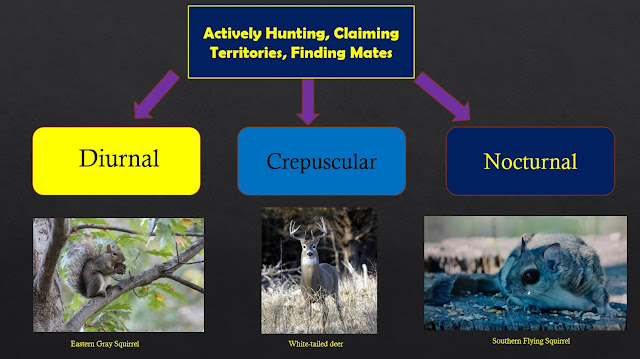
Are you a night owl?  If you're an Illinois wildlife species, than chances are, yes!  However, many animals besides owls are active at night.  In fact, the majority of wildlife species in Illinois are hunting, gathering mates, establishing territories, and moving about during the nighttime hours! A daytime walk on a trail through a forest preserve might yield some common wildlife sightings such as gray squirrels ( Sciurus carolinensis ) or sparrows.  Most animals that people see around Illinois are active during the day, or   diurnal.   Humans are a great example of a diurnal animal.   Other animals though are most active active at different times of the day (figure 1).  Late in the afternoon or early in the day, many folks encounter white-tailed deer ( Odocoileus virginianus ).  Deer are a great example of a wildlife species that is crepuscular , or active at dawn or dusk. Figure 1:  In Illinois, most wildlife species are more act...

A Naturalist's Autumn Lament

Image
Many people I know love Autumn.  They love the crisp and cool air, the color of the leaves, the fragrance of pumpkin spice, and the awe of a Jack-o-Lantern. I loath Autumn.  Everything that summer worked so hard to produce - the lush green foliage of Hickory Trees ( Carya spp. ), the showy blossoms of Hibiscus, the cheerfull calls of songbirds, the rhythmic trill of katydids, the gentle swoops of colorful butterflies, the splash of water from the neighbor's kids' Supersoaker fight, the low boom from the bass of Reggae music, the clinks and clangs of martini glasses on a balmy night, the beaches and marinas filled with happy voices, the proud croak of a bull frog, Popsicle drippings on the sidewalk, the sweet smell of Saucer Magnolia ( Magnolia sp.) flowers, fearsome thunderstorms, the swash of a canoe paddle, the blaze of prairie flowers - all begin a slow and gruesome death as the first waves of cold frosty air and biting windchills descend upon it all. The rub of cricke...

Natural Notes: Cook County and Northern Illinois Herpetology

Image
This blog post consists of notes from a lecture on herpetology in Cook County, Illinois as part of a Master Naturalist Training Series.  The speaker was Jake Huffman, a naturalist with Sand Ridge Nature Center in the Forest Preserves of Cook County.  The lecture took place at Sand Ridge Nature Center in South Holland on Friday, September 11, 2015.   Introduction/Overview The class Amphibia consists of frogs, toads, newts, and salamanders.   There are also other groups of animals that fall within class Amphibia, but they are not found in Cook County.  The word "Amphibia" is derived from Greek to mean "dual lives." Recommended field guides (titles) for identifying local amphibian include: Amphibians and Reptiles of the Great Lakes Region The Illinois Natural History Survey Common Toads and Frogs of the Chicago Region (published by the Field Museum) Some amphibians in Cook County are somewhat unusual.  Newts are a special subgroup of salamanders ...