Posts

Natural Notes: Our Essential Oaks

Image
This blog post consists of my notes from a presentation on oak ecosystems of the Greater Chicago Area.  The presenter was Kim Blaszcak, Resource Management Project Manager with the Forest Preserves of Cook County.  The presentation was delivered on October 6, 2016 at Sand Ridge Nature Center in South Holland, Illinois.   Oaks as a keystone species Oaks ( Quercus spp .) are a keystone species in the Chicago Region.  They support many organisms and ecosystem functions.  Oaks are important to wildlife through acorn production and habitat.  Oaks exhibit a periodic massive yield of acorns known as a mast year  that compensated for periods of scarcity.  Oak germination and timing of acorn production are important factors.  Red oak acorns are produced in the fall and germinate the following spring.  white oak acorns produce acorns which germinate in a single season (in the spring). Oaks are a critical food source for wildlife in North A...

Natural Notes: Seven Main Defects of Trees

Image
This blog post consists of my notes from a lecture on urban street tree defects, presented by Nick Kuhn, Resource Management Technician with the Forest Preserves of Cook County.  The presentation was delivered on September 21, 2016 at Sand Ridge Nature Center in South Holland, Illinois.   Introduction All trees experience structural failures in part or whole, including healthy trees.  It is impossible to eliminate all risks associated with tree failure.  However, recognizing signs or symptoms of compromised tree health can help mitigate or prevent problems. It is important to distinguish signs versus symptoms regarding tree health problems. Signs are physical pieces of evidence of tree health problems.  For example, D-shaped holes created by Emerald Ash Borer on a dying Ash tree are signs of an infestation.   Symptoms, on the other hand, are physical evidence that indicates a problem.  For example, excess epicormic branches emanating from th...

Natural Notes: Dragonflies and Damselflies

Image
The following blog post consists of my notes from a lecture titled "Odanata and Forest Ecology" held at Crabtree Nature Center in Barrington, Illinois in August 2016.  The lecture was delivered by Laura Brown and Nigeen Almassi, naturalists with the Forest Preserves of Cook County.   Introduction Dragonflies and Damselflies are a showy group of insects in the taxonomic order Odanata .    The primary differences between Dragonflies (class Anisoptera) and Damselflies (class Zygoptera) are their overall size (dragonflies are usually larger), the position of their wings at rest (dragonflies hold them out while damselflies usually hold them over their abdomen), the thickness of their abdomens (dragonfly abdomens are usually thicker), and their hunting habits (dragonflies are strong fliers and damselflies gently glean prey from vegetation or the water's surface).  Most damselfly wings are clear while some species, such as the Ebony Jewelwing, have colore...

Visitor FAQs: Why are birds of prey referred to as 'raptors'?

Image
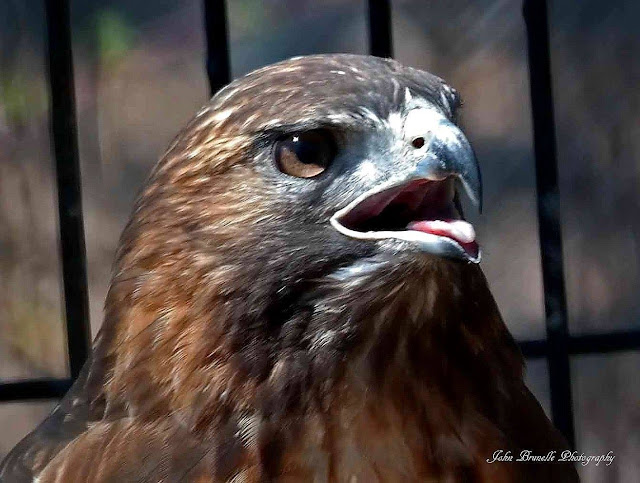
I recently watched the sequel to the Jurassic Park series of movies, Jurassic World.  I was impressed by the fact that it stayed true to the spirit and adventure of the original Jurassic Park movies but with enhanced and modernized special effects.  And of course it featured the small but fearsome "raptors", that were now fully computer animated. The other night I was leading an evening nature walk at the nature center where I work in the south suburbs of Chicago, and we were looking at our resident hawks and owl.  I mentioned that hawks and owls were members of a group of birds known as raptors, or birds of prey.  One gentlemen jumped up and exclaimed, "Raptors?  You mean like dinosaurs?"  I chuckled a bit and explained that the term raptors refers to birds of prey, not the semi-mythical dinosaurs that reach down and grab unobservant bystanders with their giant claws and gnarly teeth. The term raptor is derived from the Latin word "rapere" which loose...

A Sandy and Swampy Urban Island: A summary of ecological problems and solutions at Sand Ridge Nature Center

Image
Introduction Since September of 2014, I have been serving the Forest Preserves of Cook County as a naturalist at a Chicago-area suburban nature education center situated in a 300 acre urban nature preserve.   Sand Ridge Nature Center  (SRNC), which geographically straddles the border of South Holland and Calumet City in Illinois, is named for the ancient high Toleston Beach Ridge that formed as the water levels of Lake Michigan began receding after the end of the last major ice age (figure 1) (Forest Preserves of Cook County, 2016) .  The former 6,000 year-old beach ridge is still partially intact in several forest preserves, with one the longest remaining stretches on the northern end of the nature center property along Michigan City Road (figure 2).  The present extent of Sand Ridge Nature Center includes all of the land north of U.S. Highway 6 to Michigan City Road, then from Paxton Avenue east to Illinois Highway 83 (Torrence Avenue) along the municipal boundari...

(Not So) Natural Notes: Chicago's new Loop Link

Image
If you're traveling around town, which would be your preferred mode of travel, train or bus?  Chances are, you would choose a train.  Why is that?  Trains are easy and fun to ride, and they're quick.  They also cost less than driving, and of course using public transportation in general can reduce carbon emissions and smog, helping to improve local air quality and climate.   Why would you NOT choose a bus?  Well for one thing buses are susceptible to getting caught in traffic jams, whereas trains are free of that burden.  On top of that, buses also make frequent stops - sometimes every few blocks - which can make travel painfully slow.  For example, during rush-hour traffic in the Washington, DC metro area, buses can sometimes run 45-minutes to an hour behind schedule because of traffic and frequent stops, even though they might only be traveling a few miles or less.   So would the solution to this problem be to build new light rails o...