Posts

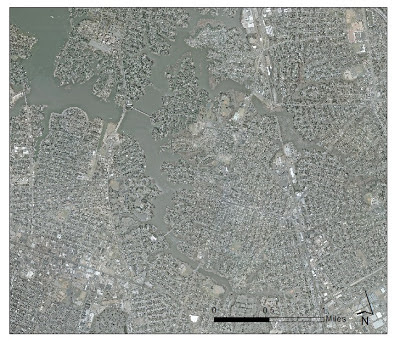
Can you give me a hint of where the green stuff is? A greenspace analysis of Norfolk, Virginia
Image
Section I:  Introduction             In an increasingly urbanized and human-developed landscape, natural lands such as forests, meadows, and streams are increasingly being divided and separated into smaller and more isolated areas.  Growing population densities across major metropolitan areas in the United States are placing available acreage of open space for public use on a premium.  As McMahon notes, a growing community usually has plans to expand its “airport, sewage treatment plant, storm water facilities, fiber optics cables, and other community utilities,” yet often ignores or omits plans to “preserve their essential life sustaining natural infrastructure,” (2000).  Greenspace in an urban setting can not only serve as a vital resource to people, it can also be beneficial in protecting wildlife and other natural resources. Norfolk, Virginia, one of the “Hampton Roads” cities in southeast Virginia, is a...

An osprey to remind us of where we've come

The other week I was sitting on expressway stuck in traffic, with the smog and the fumes fanning around my little Corolla.  I was soo anxious to get out of town and escape to the Cherry Blossom Festival up in DC for the weekend, but the daily 7 mile back up getting into the tunnel was delaying my party-time aspirations. The section of road I was parked on was a busy commuter interstate that winds right past a large military base.  If I seemed a frustrated driver, then this should not be compared to the plethora of oversized SUVs with "fuck Obama" stickers plastered all over them trying to get around all of the cars. Then, out of the corner of my eye, I saw an osprey ( Pandion haliaetus ) fly right over carrying a large stick in its talons.  It preceded to lower the stick to the top of a large metal tower, which was maybe some sort of radio control tower or a monitoring defense apparatus to ensure that terrorists don't bomb...

Becoming naturally dramatic: Tips and advice for naturalists and park rangers on doing campfire skits and shows

Image
Introduction Even at the creation of the National Park Service in 1916, ranger-led campfire programs were already well established at public camp grounds and environmental education areas.  Drawing on an age-old tradition of telling stories and gathering with friends around a crackling wood-burning fire, fireside environmental education programs are a well established activity across national, state, and many local parks and preserves.  For example, a recent seasonal position I had as a naturalist for an environmental education summer camp included performing improvised skits in front of youth around a campfire.  The skits would often reflect something on our experiencing in the outdoors, or would have some nature-themed component to them. Performing skits around a campfire, whether at a summer camp or doing interpretive programs at a national park, can aid in creating a valuable and memorable experience for...
Image
Osprey ( Pandion haliaetus ) have returned to the Bay to begin the spring season.  The call of a laughing gull ( Leucophaeus atricilla ) sounds cheerful, as if reminding everything that warmer weather is on the way.  Water oaks are beginning to burst into their pollen-heavy yellow flowers and neighbors are mulching their yards already fragrant from the blossoming of cultivated saucer magonlias (Magnolia x soulangeana).  The orchestra of the impending hot summer is beginning to tune.  Spring has started across the southern Chesapeake Bay.   The Lafayette River on a balmy early spring evening.  March 12, 2013.  Colley Avenue bridge.  (Click to enlarge)

Green is the color of wild: Why wildlife biologists need to know their plants

Image
"Plants are boring!"  "I could care less about plants."  These are words I hear spoken all too frequently by wildlife biologists and wildlife managers.  I can understand where they're coming from.  Wild animals are mysterious, exciting, showy, cute, ferocious, or just plain cool.   Wildlife biologists are field biologists who are often responsible for wildlife management, or the manipulation of wildlife populations and their habitat. Wildlife management is important for a number of different reasons, including predator control, habitat maintenance/protection, protecting endangered species, and resolving people-wildlife conflicts.  A large array of wildlife specialists such as herpetologists (reptiles and amphibians), mammalogists, ornithologists (birds) and others frequently venture into the great outdoors hoping to learn more about the biology and ecology of wild animals in an effort to protect them. Yet ...

Making the Chesapeake for everyone: My justification for affirmative action programs in Norfolk, Virginia

Image
Please note:  This blog post is in a draft stage and is intended to outline my thoughts and feelings on an important environmental issue in a certain region.  I have yet to include proper citations or to double-check my facts.  Please feel free to comment if you feel I have made some extra-erroneous remarks or overly belligerence errors, and I will work promptly to correct them.   Introduction Norfolk, Virginia is located in a region referred to as the "Tidewater area" and upon first glance of a satellite image of the region (see Figure 1) the name readily becomes apparent.  Long and narrow stretches of tidal "rivers" are woven throughout an otherwise highly urbanized area.   Figure 1:  Satellite image of Norfolk, VA and surrounding areas.            Imagery ©2013 TerraMetrics    Those tidal waters are directly connected to the  Chesapeake ...